Holidays and observances
Holidays and observances on June 24
21 holidays and special days are celebrated on June 24 around the world.
- 21observances
- 70events
Holidays and observances
 Army Day or Battle of Carabobo Day (Venezuela)An Armed Forces Day, alongside its branch-specific variants often referred to as Army or Soldier's Day, Navy or Sailor's Day, and Air Force or Aviator's Day, is a holiday dedicated to honoring the armed forces, or one of their branches, of a sovereign state, i
 Bannockburn Day (Scotland)The Battle of Bannockburn was fought on 23–24 June 1314, between the army of Robert the Bruce, King of Scots, and the army of King Edward II of England, during the First War of Scottish Independence. It was a decisive victory for Robert Bruce and formed a majo
 Christian feast day:
GohardGohard or Gunhard was a 9th-century bishop of Nantes, lord of Blain, saint and cephalophore martyr of the Roman Catholic Church.
Christian feast day:
GohardGohard or Gunhard was a 9th-century bishop of Nantes, lord of Blain, saint and cephalophore martyr of the Roman Catholic Church.- Christian feast day: Joseph YuanJoseph Yuan was a Chinese priest and martyr of the 19th century.
 Christian feast day:
María Guadalupe García ZavalaMaría Guadalupe García Zavala - born Anastasia Guadalupe García Zavala - was a Mexican Roman Catholic religious sister and the co-founder of the Handmaids of Santa Margherita and the Poor. She is also known as "Mother Lupita". At one time, she was engaged to b
Christian feast day:
María Guadalupe García ZavalaMaría Guadalupe García Zavala - born Anastasia Guadalupe García Zavala - was a Mexican Roman Catholic religious sister and the co-founder of the Handmaids of Santa Margherita and the Poor. She is also known as "Mother Lupita". At one time, she was engaged to b Christian feast day:
Nativity of Saint John the BaptistThe Nativity of John the Baptist (or Birth of John the Baptist, or Nativity of the Forerunner, or colloquially Johnmas or St. John's Day is a Christian feast day. It is observed annually on 24 June. The Nativity of John the Baptist is a high-ranking liturgical
Christian feast day:
Nativity of Saint John the BaptistThe Nativity of John the Baptist (or Birth of John the Baptist, or Nativity of the Forerunner, or colloquially Johnmas or St. John's Day is a Christian feast day. It is observed annually on 24 June. The Nativity of John the Baptist is a high-ranking liturgical Christian feast day:
Rumbold of MechlinSaint Rumbold was an Irish or Scottish Christian missionary, although his true nationality is not known for certain.
He was martyred near Mechelen by two men, whom he had denounced for their evil ways.
Christian feast day:
Rumbold of MechlinSaint Rumbold was an Irish or Scottish Christian missionary, although his true nationality is not known for certain.
He was martyred near Mechelen by two men, whom he had denounced for their evil ways. Christian feast day:
June 24 (Eastern Orthodox liturgics)June 23 - Eastern Orthodox Church calendar - June 25
Christian feast day:
June 24 (Eastern Orthodox liturgics)June 23 - Eastern Orthodox Church calendar - June 25 Day of the Caboclo (Amazonas, Brazil)A caboclo is a person of mixed Indigenous Brazilian and European ancestry, or, less commonly, a culturally assimilated or detribalized person of full Amerindian descent. In Brazil, a caboclo generally refers to this specific type of mestiço.
 Inti Raymi, a winter solstice festival and a New Year in the Andes of the Southern Hemisphere (Sacsayhuamán)The Inti Raymi is a traditional religious ceremony of the Inca Empire in honor of the god Inti, the most venerated deity in Inca religion. It was the celebration of the winter solstice – the shortest day of the year in terms of the time between sunrise and sun
 St John's Day and the second day of the Midsummer celebrations (although this is not the astronomical summer solstice, see June 20) (Roman Catholic Church, Europe), and its related observances:
Enyovden (Bulgaria)Midsummer or Midsommar is a celebration of the season of summer, taking place on or near the date of the summer solstice in the Northern Hemisphere, the longest day of the year. The name midsummer mainly refers to summer solstice festivals of European origin.
St John's Day and the second day of the Midsummer celebrations (although this is not the astronomical summer solstice, see June 20) (Roman Catholic Church, Europe), and its related observances:
Enyovden (Bulgaria)Midsummer or Midsommar is a celebration of the season of summer, taking place on or near the date of the summer solstice in the Northern Hemisphere, the longest day of the year. The name midsummer mainly refers to summer solstice festivals of European origin.  St John's Day and the second day of the Midsummer celebrations (although this is not the astronomical summer solstice, see June 20) (Roman Catholic Church, Europe), and its related observances:
Catalan Countries National Day (Andorra, Balearic Islands, Catalonia, Northern Catalonia, Valencia)The Catalan Countries refers to the territories where the Catalan language is spoken. They include the Spanish autonomous communities of Catalonia, the Balearic Islands, Valencian Community, and parts of Aragon and Murcia (Carche), as well as the Principality
St John's Day and the second day of the Midsummer celebrations (although this is not the astronomical summer solstice, see June 20) (Roman Catholic Church, Europe), and its related observances:
Catalan Countries National Day (Andorra, Balearic Islands, Catalonia, Northern Catalonia, Valencia)The Catalan Countries refers to the territories where the Catalan language is spoken. They include the Spanish autonomous communities of Catalonia, the Balearic Islands, Valencian Community, and parts of Aragon and Murcia (Carche), as well as the Principality - St John's Day and the second day of the Midsummer celebrations (although this is not the astronomical summer solstice, see June 20) (Roman Catholic Church, Europe), and its related observances: Jaanipäev (Estonia) Jaanipäev and jaaniõhtu, also jaanilaupäev are the most important days in the Estonian calendar. The short summer seasons with long days and brief nights hold special significance for the people of Estonia. Jaanipäev is celebrated on the night between June 23
 St John's Day and the second day of the Midsummer celebrations (although this is not the astronomical summer solstice, see June 20) (Roman Catholic Church, Europe), and its related observances:
Jāņi (Latvia)Jāņi is an annual Latvian festival celebrating the summer solstice. Although, astronomically the solstice falls on the 21st or 22nd of June, the public holidays—Līgo Day and Jāņi Day—are on the 23rd and 24th of June. The day before Jāņi is known as Līgosvētki,
St John's Day and the second day of the Midsummer celebrations (although this is not the astronomical summer solstice, see June 20) (Roman Catholic Church, Europe), and its related observances:
Jāņi (Latvia)Jāņi is an annual Latvian festival celebrating the summer solstice. Although, astronomically the solstice falls on the 21st or 22nd of June, the public holidays—Līgo Day and Jāņi Day—are on the 23rd and 24th of June. The day before Jāņi is known as Līgosvētki,- St John's Day and the second day of the Midsummer celebrations (although this is not the astronomical summer solstice, see June 20) (Roman Catholic Church, Europe), and its related observances: Jónsmessa (Iceland)Jónsmessa, also known as Midsummer Night, is an Icelandic holiday celebrated on June 24 and named after John the Baptist. According to Icelandic folklore, cows gain the powers of speech, seals become human, and it is healthy to roll naked in the dew-covered gr
 St John's Day and the second day of the Midsummer celebrations (although this is not the astronomical summer solstice, see June 20) (Roman Catholic Church, Europe), and its related observances:
Midsummer Day (England)Midsummer or Midsommar is a celebration of the season of summer, taking place on or near the date of the summer solstice in the Northern Hemisphere, the longest day of the year. The name midsummer mainly refers to summer solstice festivals of European origin.
St John's Day and the second day of the Midsummer celebrations (although this is not the astronomical summer solstice, see June 20) (Roman Catholic Church, Europe), and its related observances:
Midsummer Day (England)Midsummer or Midsommar is a celebration of the season of summer, taking place on or near the date of the summer solstice in the Northern Hemisphere, the longest day of the year. The name midsummer mainly refers to summer solstice festivals of European origin.  St John's Day and the second day of the Midsummer celebrations (although this is not the astronomical summer solstice, see June 20) (Roman Catholic Church, Europe), and its related observances:
Saint Jonas' Festival or Joninės (Lithuania)Saint Jonas's Festival, also known as Rasos, Joninės, Kupolė, Midsummer Day or Saint John's Day) is a Lithuanian midsummer folk festival celebrated on 24 June all around Lithuania and by the Lithuanian diaspora worldwide. The celebrations often involve flower
St John's Day and the second day of the Midsummer celebrations (although this is not the astronomical summer solstice, see June 20) (Roman Catholic Church, Europe), and its related observances:
Saint Jonas' Festival or Joninės (Lithuania)Saint Jonas's Festival, also known as Rasos, Joninės, Kupolė, Midsummer Day or Saint John's Day) is a Lithuanian midsummer folk festival celebrated on 24 June all around Lithuania and by the Lithuanian diaspora worldwide. The celebrations often involve flower  St John's Day and the second day of the Midsummer celebrations (although this is not the astronomical summer solstice, see June 20) (Roman Catholic Church, Europe), and its related observances:
Saint-Jean-Baptiste Day (Quebec)Saint-Jean-Baptiste Day, also known in English as St John the Baptist Day, is a holiday celebrated on June 24 in the Canadian province of Quebec. It was brought to Canada by French settlers celebrating the traditional feast day of the Nativity of Saint John th
St John's Day and the second day of the Midsummer celebrations (although this is not the astronomical summer solstice, see June 20) (Roman Catholic Church, Europe), and its related observances:
Saint-Jean-Baptiste Day (Quebec)Saint-Jean-Baptiste Day, also known in English as St John the Baptist Day, is a holiday celebrated on June 24 in the Canadian province of Quebec. It was brought to Canada by French settlers celebrating the traditional feast day of the Nativity of Saint John th St John's Day and the second day of the Midsummer celebrations (although this is not the astronomical summer solstice, see June 20) (Roman Catholic Church, Europe), and its related observances:
Sânziene (western Carpathian Mountains of Romania)Sânziană is the Romanian name for gentle fairies who play an important part in local folklore, also used to designate the Galium verum or Cruciata laevipes flowers. Under the plural form Sânziene, the word designates an annual festival in the fairies' honor. E
St John's Day and the second day of the Midsummer celebrations (although this is not the astronomical summer solstice, see June 20) (Roman Catholic Church, Europe), and its related observances:
Sânziene (western Carpathian Mountains of Romania)Sânziană is the Romanian name for gentle fairies who play an important part in local folklore, also used to designate the Galium verum or Cruciata laevipes flowers. Under the plural form Sânziene, the word designates an annual festival in the fairies' honor. E St John's Day and the second day of the Midsummer celebrations (although this is not the astronomical summer solstice, see June 20) (Roman Catholic Church, Europe), and its related observances:
Wattah Wattah Festival (Philippines)The Wattah Wattah Festival, also known as the Basaan Festival, is the feast of John the Baptist, the patron saint of San Juan, Metro Manila, and many other communities across the Philippines. It is held every June 24.
St John's Day and the second day of the Midsummer celebrations (although this is not the astronomical summer solstice, see June 20) (Roman Catholic Church, Europe), and its related observances:
Wattah Wattah Festival (Philippines)The Wattah Wattah Festival, also known as the Basaan Festival, is the feast of John the Baptist, the patron saint of San Juan, Metro Manila, and many other communities across the Philippines. It is held every June 24. Fors Fortuna, ancient Roman festival to FortunaFortuna, sometimes anglicized as Fortune, is the goddess of luck or fortune in Roman religion. She came to represent life's capriciousness, and was a goddess of fate. In antiquity she was also known by the epithet Automatia. Her Greek equivalent is Tyche.
Frequently asked questions
What is celebrated on June 24?
21 observances are celebrated on June 24 around the world: Army Day or Battle of Carabobo Day (Venezuela), Bannockburn Day (Scotland), Christian feast day: Gohard, Christian feast day: Joseph Yuan, Christian feast day: María Guadalupe García Zavala, Christian feast day: Nativity of Saint John the Baptist. The list gathers national holidays, international days and religious or civil observances falling on this date in different countries, as recorded on Wikipedia. Some are fixed and recur on the same day every year; others depend on the local calendar. Each links to the article explaining its origin and meaning.
What happened on June 24?
70 documented historical events happened on June 24, from antiquity to the present day. The best known is this: Western Roman emperor Glycerius, who was not recognized by his Eastern counterpart Leo I, was forced to abdicate. On the same day, in another year: In the decisive battle of the First War of Scottish Independence, Scottish forces led by Robert the Bruce defeated English troops under Edward II near Bannockburn, Scotland. On Almanaccolo every event is listed in chronological order, grouped by century, and links to the Wikipedia article it comes from, so you can always read further or check the source. Alongside the events you find who was born and who died on this date, and which observances are celebrated around the world.
Keep exploring
Free app
Every day’s history, in your pocket
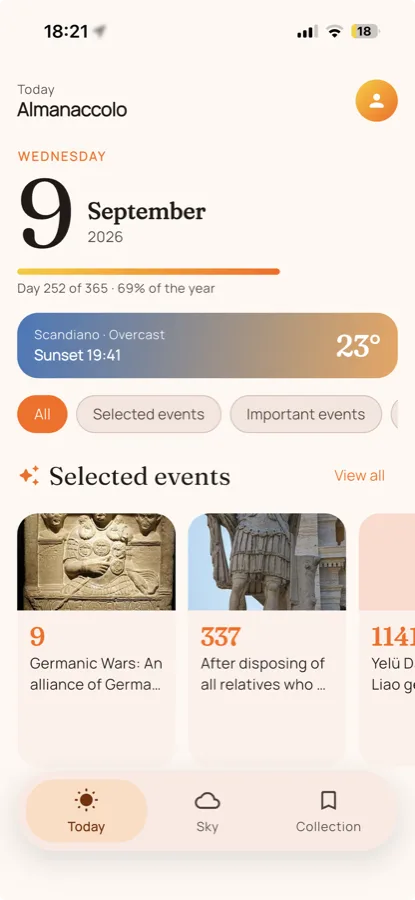
Almanaccolo greets you each morning with the almanac of the day, sunrise and sunset times and your saved events.
- Today’s almanac, every morning
- Save the events that strike you
- Sunrise, sunset and weather for your city
- Free, no account required