Sunrise and sunset
Sunrise and sunset in St Petersburg
Wednesday 9 september 2026 · St Petersburg, Russia
Sunrise
06:11
Sunset
19:40
- Day length: 13 hours and 29 minutes
- Solar noon: 12:56
Twilight
Civil
You can still read outdoors without artificial light.
- Begins
- 05:28
- Ends
- 20:23
Nautical
The sea horizon is still visible.
- Begins
- 04:34
- Ends
- 21:18
Astronomical
The sky is fully dark: stargazing begins.
- Begins
- 03:30
- Ends
- 22:22
2026 solar calendar
Sunrise and sunset on the 1st and 15th of each month.
| Month | Sunrise | Sunset | Day length |
|---|---|---|---|
| January 1 | 10:00 | 16:03 | 6 hours and 3 minutes |
| 15 | 09:46 | 16:29 | 6 hours and 43 minutes |
| February 1 | 09:13 | 17:11 | 7 hours and 58 minutes |
| 15 | 08:37 | 17:48 | 9 hours and 11 minutes |
| March 1 | 07:58 | 18:24 | 10 hours and 26 minutes |
| 15 | 07:16 | 18:59 | 11 hours and 43 minutes |
| April 1 | 06:24 | 19:40 | 13 hours and 16 minutes |
| 15 | 05:43 | 20:14 | 14 hours and 32 minutes |
| May 1 | 04:57 | 20:54 | 15 hours and 57 minutes |
| 15 | 04:21 | 21:28 | 17 hours and 6 minutes |
| June 1 | 03:48 | 22:04 | 18 hours and 15 minutes |
| 15 | 03:35 | 22:22 | 18 hours and 47 minutes |
| July 1 | 03:41 | 22:23 | 18 hours and 42 minutes |
| 15 | 04:02 | 22:06 | 18 hours and 4 minutes |
| August 1 | 04:39 | 21:30 | 16 hours and 52 minutes |
| 15 | 05:12 | 20:53 | 15 hours and 41 minutes |
| September 1 | 05:53 | 20:04 | 14 hours and 11 minutes |
| 15 | 06:25 | 19:22 | 12 hours and 56 minutes |
| October 1 | 07:03 | 18:33 | 11 hours and 30 minutes |
| 15 | 07:37 | 17:52 | 10 hours and 15 minutes |
| November 1 | 08:19 | 17:04 | 8 hours and 45 minutes |
| 15 | 08:55 | 16:31 | 7 hours and 36 minutes |
| December 1 | 09:32 | 16:02 | 6 hours and 30 minutes |
| 15 | 09:54 | 15:52 | 5 hours and 58 minutes |
January: on the first of the month in St Petersburg the sun rises at 10:00 and sets at 16:03, for 6 hours and 3 minutes of daylight.
February: on the first of the month in St Petersburg the sun rises at 09:13 and sets at 17:11, for 7 hours and 58 minutes of daylight.
March: on the first of the month in St Petersburg the sun rises at 07:58 and sets at 18:24, for 10 hours and 26 minutes of daylight.
April: on the first of the month in St Petersburg the sun rises at 06:24 and sets at 19:40, for 13 hours and 16 minutes of daylight.
May: on the first of the month in St Petersburg the sun rises at 04:57 and sets at 20:54, for 15 hours and 57 minutes of daylight.
June: on the first of the month in St Petersburg the sun rises at 03:48 and sets at 22:04, for 18 hours and 15 minutes of daylight.
July: on the first of the month in St Petersburg the sun rises at 03:41 and sets at 22:23, for 18 hours and 42 minutes of daylight.
August: on the first of the month in St Petersburg the sun rises at 04:39 and sets at 21:30, for 16 hours and 52 minutes of daylight.
September: on the first of the month in St Petersburg the sun rises at 05:53 and sets at 20:04, for 14 hours and 11 minutes of daylight.
October: on the first of the month in St Petersburg the sun rises at 07:03 and sets at 18:33, for 11 hours and 30 minutes of daylight.
November: on the first of the month in St Petersburg the sun rises at 08:19 and sets at 17:04, for 8 hours and 45 minutes of daylight.
December: on the first of the month in St Petersburg the sun rises at 09:32 and sets at 16:02, for 6 hours and 30 minutes of daylight.
Times are computed with the NOAA solar algorithm from the city coordinates and shown in its local time zone.
Frequently asked questions
What time does the sun set in St Petersburg?
Today the sun sets at 19:40 in St Petersburg, Russia, after 13 hours and 29 minutes of daylight that began with sunrise at 06:11. Darkness does not fall at once: civil twilight lasts until 20:23, and until then you can still read outdoors without artificial light. Sunset shifts by a minute or two each day because of the tilt of the Earth's axis: this page has the calendar for the whole year, with sunrise and sunset on the 1st and 15th of each month. Times are computed with the NOAA solar algorithm from the city coordinates and shown in its local time zone.
What time does the sun rise in St Petersburg?
Today sunrise in St Petersburg, Russia is at 06:11, and daylight lasts 13 hours and 29 minutes until sunset at 19:40. The day actually begins earlier: civil twilight starts at 05:28, when the sky brightens while the sun is still below the horizon. Solar noon, when the sun is at its highest, falls at 12:56. Sunrise is the moment the upper edge of the sun appears on the horizon, accounting for atmospheric refraction: the same definition used by astronomical observatories.
What is the difference between the three twilights?
The three twilights differ by how far the sun has dropped below the horizon. Civil twilight reaches 6 degrees: in St Petersburg it ends at 20:23 today, the hour when you can no longer read outdoors without artificial light. Nautical twilight extends to 12 degrees, today until 21:18: while it lasts, the sea horizon stays visible and sextant navigation works. Astronomical twilight ends at 18 degrees, today at 22:22: from then the sky is fully dark and even faint stars appear. In the morning the sequence runs in reverse, starting at 03:30.
Nearby cities
Free app
Every day’s history, in your pocket
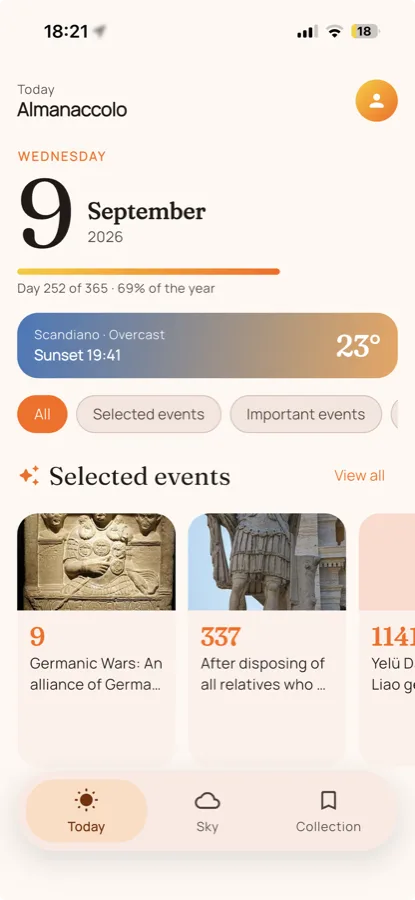
Almanaccolo greets you each morning with the almanac of the day, sunrise and sunset times and your saved events.
- Today’s almanac, every morning
- Save the events that strike you
- Sunrise, sunset and weather for your city
- Free, no account required