Magnitude is not a linear scale
Each extra point multiplies released energy by about 32. A magnitude 6 is not twice a magnitude 3: it releases thirty-two thousand times as much. That is why the decimals in a bulletin genuinely matter.
In the app
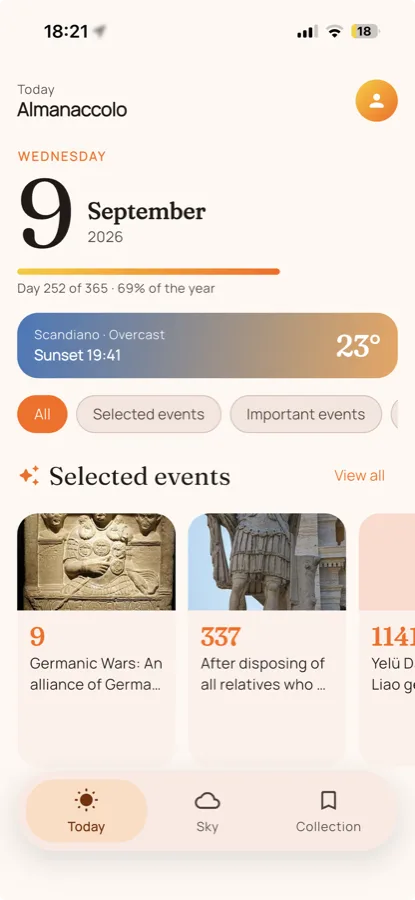
Almanaccolo lists recent earthquakes within 300 kilometres of where you are, with magnitude, depth and distance from the epicentre.
Each extra point multiplies released energy by about 32. A magnitude 6 is not twice a magnitude 3: it releases thirty-two thousand times as much. That is why the decimals in a bulletin genuinely matter.
A magnitude 4 at five kilometres deep is felt more than a magnitude 5 at two hundred. Depth tells you how much rock sits between the epicentre and the surface: destructive quakes are almost always shallow ones.
| Magnitude | Effect | Frequency worldwide |
|---|---|---|
| < 2 | Not felt | Millions a year, instruments only. |
| 2–3 | Rarely felt | Over a million a year. |
| 3–4 | Felt indoors | Around 100,000 a year. |
| 4–5 | Objects rattle | Around 10,000 a year. |
| 5–6 | Damage to weak buildings | Around 1,500 a year. |
| 6–7 | Serious damage up to 100 km | Around 130 a year. |
| 7+ | Destructive over a wide area | About fifteen a year. |
Data: USGS
It measures the energy released. It is not a linear scale: each extra point multiplies energy by about 32, so a magnitude 6 releases thirty-two thousand times more than a magnitude 3.
Because there is more rock between the epicentre and the surface to absorb the energy. A magnitude 4 at five kilometres deep is felt more than a magnitude 5 at two hundred.
Free app
Almanaccolo greets you each morning with the almanac of the day, sunrise and sunset times and your saved events.