Holidays and observances
Holidays and observances on January 14
22 holidays and special days are celebrated on January 14 around the world.
- 22observances
- 30events
Holidays and observances
- Christian feast day: Barba'shminBarbaʿshmin, also called Barbasceminus, was a fourth-century bishop of Seleucia-Ctesiphon, primate of the Church of the East, and martyr. He succeeded Shahdost as bishop of Seleucia-Ctesiphon in 343, during the great persecution of Shapur II, and was martyred
 Christian feast day:
Devasahayam Pillai (Catholic Church)'Devasahayam Pillai’ was an Indian layman and martyr of the Catholic Church. He was canonized as a saint of the church by Pope Francis on 15 May 2022.
Christian feast day:
Devasahayam Pillai (Catholic Church)'Devasahayam Pillai’ was an Indian layman and martyr of the Catholic Church. He was canonized as a saint of the church by Pope Francis on 15 May 2022. Christian feast day:
Divina Pastora (Barquisimeto)Divina Pastora is a statue of the Madonna and Child, the Virgin Mary holding the infant Jesus, with a lamb at her side. It is considered to be one of the most important religious icons of Venezuela. Divina Pastora is the patroness saint of the city of Barquisi
Christian feast day:
Divina Pastora (Barquisimeto)Divina Pastora is a statue of the Madonna and Child, the Virgin Mary holding the infant Jesus, with a lamb at her side. It is considered to be one of the most important religious icons of Venezuela. Divina Pastora is the patroness saint of the city of Barquisi Christian feast day:
Eivind Berggrav (Lutheran)Eivind Josef Berggrav was a Norwegian Lutheran bishop. As primate of the Church of Norway, Berggrav became known for his central role in the Church of Norway's resistance against the Nazi occupation of Norway during World War II. Berggrav also became an import
Christian feast day:
Eivind Berggrav (Lutheran)Eivind Josef Berggrav was a Norwegian Lutheran bishop. As primate of the Church of Norway, Berggrav became known for his central role in the Church of Norway's resistance against the Nazi occupation of Norway during World War II. Berggrav also became an import Christian feast day:
Felix of NolaFelix of Nola was a Christian priest at Nola near Naples in Italy. He sold off his possessions to give to the poor, but was arrested and tortured for his Christian faith during the persecution of Roman Emperor Decius. He was believed to have died a martyr's de
Christian feast day:
Felix of NolaFelix of Nola was a Christian priest at Nola near Naples in Italy. He sold off his possessions to give to the poor, but was arrested and tortured for his Christian faith during the persecution of Roman Emperor Decius. He was believed to have died a martyr's de- Christian feast day: Macrina the ElderMacrina the Elder was the mother of Basil the Elder, and the grandmother of Basil the Great, Gregory of Nyssa, Peter of Sebaste, and Macrina the Younger.
 Christian feast day:
Odoric of PordenoneOdoric of Pordenone was a Franciscan friar and missionary explorer from Friuli in northeast Italy. He journeyed through India, Sumatra, Java, and China, where he spent three years in the imperial capital of Khanbaliq. After more than ten years of travel, he re
Christian feast day:
Odoric of PordenoneOdoric of Pordenone was a Franciscan friar and missionary explorer from Friuli in northeast Italy. He journeyed through India, Sumatra, Java, and China, where he spent three years in the imperial capital of Khanbaliq. After more than ten years of travel, he re Christian feast day:
January 14 (Eastern Orthodox liturgics)January 14 in Eastern Orthodox liturgical calendars is a feast day and a day of commemoration of saints and martyrs. Although some Orthodox churches use the Revised Julian Calendar and others use the traditional Julian calendar, the fixed commemorations for th
Christian feast day:
January 14 (Eastern Orthodox liturgics)January 14 in Eastern Orthodox liturgical calendars is a feast day and a day of commemoration of saints and martyrs. Although some Orthodox churches use the Revised Julian Calendar and others use the traditional Julian calendar, the fixed commemorations for th Defender of the Motherland Day (Uzbekistan)Defenders of the Motherland Day also known as Uzbek Army Day is a holiday observed in Uzbekistan. It is celebrated on 14 January. It is the official professional holiday of the Uzbek Armed Forces.
 Feast of the Ass (Medieval Christianity)The Feast of the Ass is a medieval Christian feast observed on 14 January, celebrating the flight into Egypt. It was originally celebrated primarily in France, as a by-product of the Feast of Fools celebrating the donkey-related stories in the Bible, in partic
 Flag Day (Georgia)A flag day is a flag-related holiday, a day designated for flying a certain flag or a day set aside to celebrate a historical event such as a nation's adoption of its flag.
- National Forest Conservation Day (Thailand) Public holidays in Thailand are regulated by the government, and most are observed by both the public and private sectors. There are usually nineteen public holidays in a year, but more may be declared by the cabinet. Other observances, both official and non
- Old New Year, and its related observance: Azhyrnykhua (Abkhazia) The following is a list of public holidays in Abkhazia. The working days are marked in cursive.
 Old New Year, and its related observance:
Yennayer (Berbers)Yennayer is the first month of the Berber (Amazigh) calendar. The first day of Yennayer corresponds to the first day of January in the Julian Calendar, which is shifted thirteen days compared to the Gregorian calendar, thus falling on 12 January every year. Th
Old New Year, and its related observance:
Yennayer (Berbers)Yennayer is the first month of the Berber (Amazigh) calendar. The first day of Yennayer corresponds to the first day of January in the Julian Calendar, which is shifted thirteen days compared to the Gregorian calendar, thus falling on 12 January every year. Th Ratification Day (United States)Ratification Day in the United States is the anniversary of the congressional proclamation of the ratification of the Treaty of Paris, on January 14, 1784, at the Maryland State House in Annapolis, Maryland, by the Confederation Congress, which marked the offi
 Sidereal winter solstice celebrations in South and Southeast Asian cultures; marking the transition of the Sun to Capricorn, and the first day of the six months Uttarayana period. (see April 14):
Magh Bihu (Assam)Magh Bihu (also called Bhogali Bihu or Maghar Domahi is a harvest festival celebrated in Assam, North-East India, which marks the end of harvesting season in the month of Magh. A bonfire is lit for the ceremonial conclusion and prayer to the God of Fire. Part
Sidereal winter solstice celebrations in South and Southeast Asian cultures; marking the transition of the Sun to Capricorn, and the first day of the six months Uttarayana period. (see April 14):
Magh Bihu (Assam)Magh Bihu (also called Bhogali Bihu or Maghar Domahi is a harvest festival celebrated in Assam, North-East India, which marks the end of harvesting season in the month of Magh. A bonfire is lit for the ceremonial conclusion and prayer to the God of Fire. Part  Sidereal winter solstice celebrations in South and Southeast Asian cultures; marking the transition of the Sun to Capricorn, and the first day of the six months Uttarayana period. (see April 14):
Maghe Sankranti (Nepal)Maghe Sankranti is a Nepali festival observed on the first day of Magh in the Vikram Sambat (B.S) or Yele calendar, marking the end of the winter solstice and the month of Poush. The Tharu people celebrate this day as the beginning of their new year. It is als
Sidereal winter solstice celebrations in South and Southeast Asian cultures; marking the transition of the Sun to Capricorn, and the first day of the six months Uttarayana period. (see April 14):
Maghe Sankranti (Nepal)Maghe Sankranti is a Nepali festival observed on the first day of Magh in the Vikram Sambat (B.S) or Yele calendar, marking the end of the winter solstice and the month of Poush. The Tharu people celebrate this day as the beginning of their new year. It is als- Sidereal winter solstice celebrations in South and Southeast Asian cultures; marking the transition of the Sun to Capricorn, and the first day of the six months Uttarayana period. (see April 14): Maghi (Punjab, Haryana, Himachal Pradesh)Maghi is a Punjabi cultural festival, the Indian harvest festival celebrated on winter solstice. Maghi falls on the first day of the month of Magh and is celebrated in Punjab, Haryana, Jammu and Himachal Pradesh. It follows on the heels of the mid-winter festi
 Sidereal winter solstice celebrations in South and Southeast Asian cultures; marking the transition of the Sun to Capricorn, and the first day of the six months Uttarayana period. (see April 14):
Makar Sankranti (India)Makar(a) Sankrānti also referred to as Uttarāyana, Makara, or simply Sankrānti, is a Hindu observance and a mid-winter harvest festival in India and Nepal. Hindus worship Surya, the Sun god, in Makar Sankranti. It is typically celebrated on 14 January annually
Sidereal winter solstice celebrations in South and Southeast Asian cultures; marking the transition of the Sun to Capricorn, and the first day of the six months Uttarayana period. (see April 14):
Makar Sankranti (India)Makar(a) Sankrānti also referred to as Uttarāyana, Makara, or simply Sankrānti, is a Hindu observance and a mid-winter harvest festival in India and Nepal. Hindus worship Surya, the Sun god, in Makar Sankranti. It is typically celebrated on 14 January annually Sidereal winter solstice celebrations in South and Southeast Asian cultures; marking the transition of the Sun to Capricorn, and the first day of the six months Uttarayana period. (see April 14):
The first day of Pongal (Tamil Nadu)Pongal is a multi-day Hindu harvest festival celebrated by Tamils. The festival is celebrated over three or four consecutive days, which are named Bhogi, Thai Pongal, Mattu Pongal and Kaanum Pongal, beginning on the last day of the Tamil calendar month of Marg
Sidereal winter solstice celebrations in South and Southeast Asian cultures; marking the transition of the Sun to Capricorn, and the first day of the six months Uttarayana period. (see April 14):
The first day of Pongal (Tamil Nadu)Pongal is a multi-day Hindu harvest festival celebrated by Tamils. The festival is celebrated over three or four consecutive days, which are named Bhogi, Thai Pongal, Mattu Pongal and Kaanum Pongal, beginning on the last day of the Tamil calendar month of Marg- Sidereal winter solstice celebrations in South and Southeast Asian cultures; marking the transition of the Sun to Capricorn, and the first day of the six months Uttarayana period. (see April 14): Uttarayan (Uttarakhand, Gujarat and Rajasthan)The term Uttarāyaṇa is derived from two different Sanskrit words – "uttaram" (North) and "ayanam" (movement) – thus indicating the northward movement of the Sun. In the Gregorian calendar, this pertains to the "actual movement of the sun with respect to the ea
- World Logic Day (UNESCO)World Logic Day is an international day proclaimed by UNESCO in association with the International Council for Philosophy and Human Sciences (CIPSH) in November 2019 to be celebrated on 14 January every year. It was first celebrated on 14 January 2019, before
Frequently asked questions
What is celebrated on January 14?
22 observances are celebrated on January 14 around the world: Christian feast day: Barba'shmin, Christian feast day: Devasahayam Pillai (Catholic Church), Christian feast day: Divina Pastora (Barquisimeto), Christian feast day: Eivind Berggrav (Lutheran), Christian feast day: Felix of Nola, Christian feast day: Macrina the Elder. The list gathers national holidays, international days and religious or civil observances falling on this date in different countries, as recorded on Wikipedia. Some are fixed and recur on the same day every year; others depend on the local calendar. Each links to the article explaining its origin and meaning.
What happened on January 14?
30 documented historical events happened on January 14, from antiquity to the present day. The best known is this: King Andrew III died without any male heirs, ending the Árpád dynasty, which had ruled Hungary since the late 9th century. On the same day, in another year: Dutch–Portuguese War: The Dutch siege of Malacca against the Portuguese ended when Dutch troops seized the city's citadel (depicted). On Almanaccolo every event is listed in chronological order, grouped by century, and links to the Wikipedia article it comes from, so you can always read further or check the source. Alongside the events you find who was born and who died on this date, and which observances are celebrated around the world.
Keep exploring
Free app
Every day’s history, in your pocket
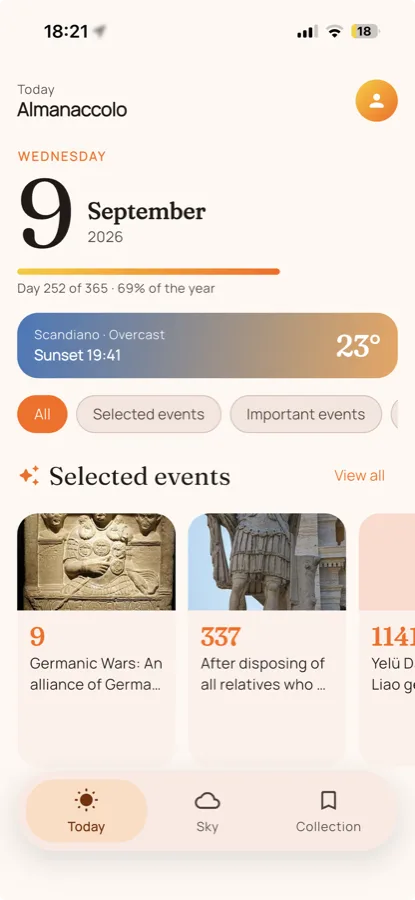
Almanaccolo greets you each morning with the almanac of the day, sunrise and sunset times and your saved events.
- Today’s almanac, every morning
- Save the events that strike you
- Sunrise, sunset and weather for your city
- Free, no account required